

By Van Mitchell, staff writer

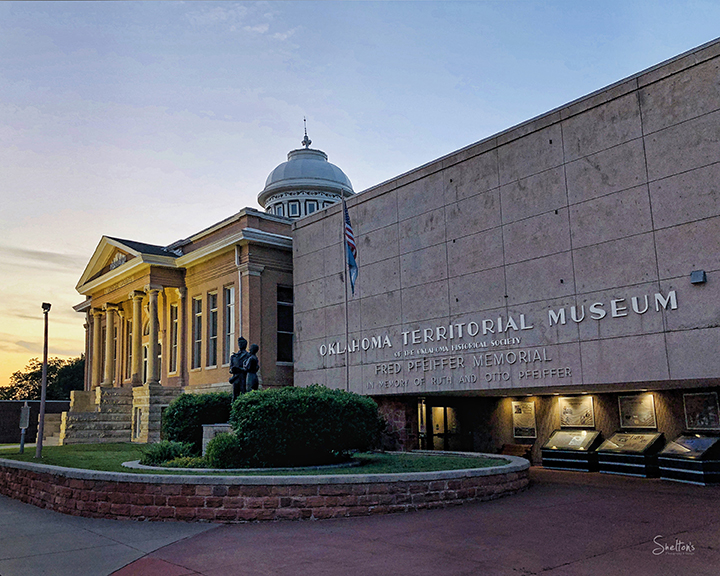
Through artifacts, photographs, and paintings, the Oklahoma Territorial Museum and Carnegie Library, located at 406 E. Oklahoma Avenue in Guthrie share the story of the determined people who laid the foundation for the state of Oklahoma.
Preserved by the Oklahoma Historical Society, the library and the museum serve as a visible link between Oklahoma’s turbulent territorial period and the present.
“We talk about the events leading up to the land run of 1889, and then following that, the creation of Oklahoma territory, which is not the entire state,” Michael D. Williams, Site Director of the Oklahoma Territorial Museum and Carnegie Library said. “It is one of those things that people confuse a lot. It is the western half of the state that becomes Oklahoma Territory, and then the movement to statehood and the removal of the capital from Guthrie to Oklahoma City. Our timeframe runs about 1870 to 1910.”
The Oklahoma Territorial Museum and Carnegie Library are open Tuesday through Saturday 9 a.m. to 5 p.m.
The Carnegie Library, built in 1902, was initially constructed with a grant from the Carnegie Foundation. On Nov. 16, 1907, statehood ceremonies were held on its steps with great fanfare.
In 1972, Guthrie’s city leaders announced plans to demolish the Carnegie Library, and Fred Pfeiffer sought to preserve the structure with the addition of a museum. Thanks to Pfeiffer’s efforts, a museum was built on the adjacent lot, officially opening on Nov. 16, 1973. Eventually, the buildings were joined and now coexist as the museum.
Oklahoma Territory was formed in 1890 and existed for only 17 years. During that short time, the land was transformed into an area of prosperous farms and growing cities.
In 1889 Congress opened nearly 2 million acres of land for settlement in central Oklahoma. Known as the Unassigned Lands, the area was formerly held by the Muscogee (Creek) and Seminole Nations before the Civil War. At noon on April 22, 1889, the day of the opening, thousands of hopeful land-seekers rushed in to stake a claim. At the end of that first day, laws were being established in the cities of Guthrie, Stillwater, Norman, and Oklahoma City.
Williams said the museum tells stories about Oklahoma before the Land Run.
“Some of the stories that we tell go back further. They go back to 1866. That’s the Reconstruction treaties with the Five Tribes after the Civil War,” he said. “We get a lot of people when they come in here and we talk to them; they don’t realize that the Five Tribes had sided with the Confederacy during the Civil War. And because of that, they abrogated the treaties and they started over. And so, we must go into that a lot. It is a cool story.”
After the Land a homesteader’s first task was the construction of a suitable home. The typical post-run farm dwelling was usually a “soddy,” constructed from bricks of prairie sod, or a dugout built into the side of a hill.
The homesteader next turned his attention to the planting of crops. The run occurred too late in the season for a cash crop to be planted, so the new arrivals grew vegetables that they hoped would last through the winter. The following seasons brought only hard times in the form of drought and depression. It was not until 1897 that good crops brought territorial farmers a degree of prosperity.
Not everyone came to the area in search of farmland. Many came to establish businesses or ply trades in the towns that sprang into existence. Along with the merchants, tradesmen, and professionals came saloon keepers, gamblers, and prostitutes, lending a colorful element to the era. In 1890 most of western Oklahoma, including the Unassigned Lands, were accorded territorial status. Guthrie was named the territorial capital.
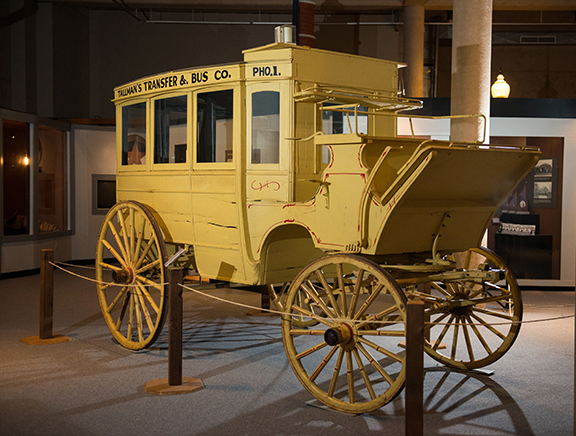
Williams said the museum tries to have new displays every year to better tell Oklahoma’s history.
“We try to have new exhibits every year, and we try to do a small one in the springtime that’s usually associated with an intern that we have,” he said. “It’d be like one object that they’ll talk about and write a couple panels on. In the fall, we like to have a new one outside. We have an outside display area, and so we like to put something out there in the fall. And then every couple of years we try to do a bigger exhibition in the Carnegie Library. We did one on the Wizard of Oz and what the characters in the Wizard of Oz represent at the time, and I’m talking about the book more so than the movie.”
Williams said the Carnegie Library is utilized for bigger exhibits.
“We’ve got a little more room to tell bigger stories in the Carnegie than we do in the territorial museum part of the facility,” he said. “And then we’re looking at redoing our two galleries. We’ve got upstairs in a downstairs gallery, and they’ve not been redone except for just small exhibits within the larger exhibits, probably since 2006.”
Williams said they are looking to remodel their upstairs and downstairs galleries.
“All this kind of boils down to availability of funding for such projects,” he said. “But we’re looking to, in the next three to five years, completely guttithe first and second floor and redoing all the exhibits and modernizing, and that’s probably a $ 1 million dollar project to do that. We’ve got a lot of work to do.”
Williams said the museum averages between 15,000 to 20,000 visitors a year.
“We do a lot of school groups. We do a lot of educational programming,” he said. “We bring speakers in from all over the place and make that available to the people in the community.”
Williams said he wants visitors to the museum to be inspired to ask questions.
“We want people to go through the museum and be inspired to ask us a question on the way out. We want them to ask us stuff. We want them to buy books to get a deeper understanding of what they saw in the museum,” he said. “We want to trigger that in people that, huh, this is not what I thought. It’s like, I need to know more about this because it’s making me question things. That’s really what we want. We want to inspire people to question.”
Museum and Library admission is free for Oklahoma Historical Society members; Adults $10, Seniors 62+, $8, Students 6-18 $5, and children 5 and under and Veterans and Active Military (with ID) are free.
For more information call (405) 282-1889 or visit https://www.okhistory.org/sites/territorialmuseum.