

by Van Mitchell, staff writer
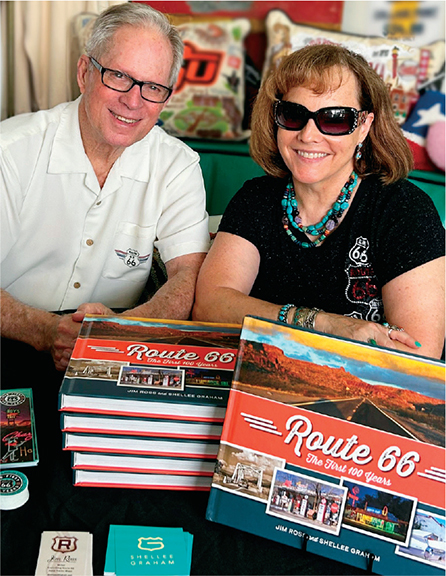
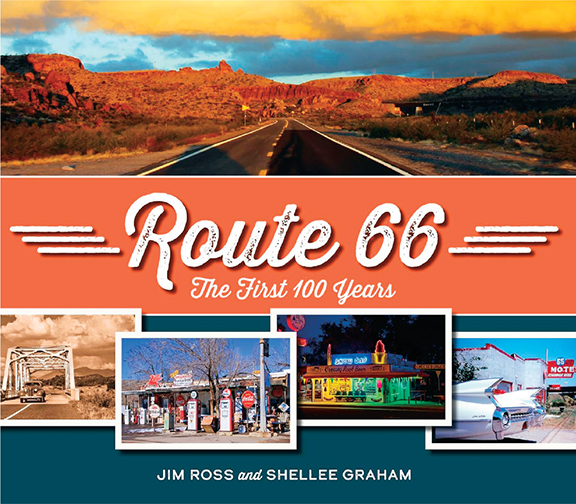
Route 66 turns 100 years old in 2026, and the historic highway is highlighted in a new book “Route 66-The First 100 Years,” co-authored by acclaimed Route 66 ambassadors Jim Ross and Shellee Graham.

The book is crafted from crafted from three decades of traveling, photographing, and writing about the route by Ross and Graham.
Previous books by them include “Route 66 Sightings, Tales from the Coral Court, Route 66 Crossings, and Secret Route 66.”
Their new book explores the route from its birth in 1926 through its centennial, and experience the events, people, and places that created the legacy ensuring America’s Mother Road a place in the hearts and minds of the nation.
Route 66 was one of the United States’ first continuous stretches of paved highway and served as a major path for those who migrated to the West.
The numerical route designation “66” was assigned to the Chicago-to-Los Angeles route on April 30, 1926. “The Mother Road” was officially established on November 11, 1926, and ultimately stretched 2,448 miles (3,940 kilometers) from Chicago to Los Angeles. It became the shortest, year-round route between the Midwest and the Pacific Coast, and was
also known as “The Main Street of America” and the “Will Rogers Highway”. On that date, only 800 miles of Route 66 were paved, the rest being graded dirt, gravel, bricks, or planks of wood. It took 11 more years before the entire road would be paved.
From its beginning in Chicago, Route 66 headed southwest through Illinois and Missouri, and a small section of southeast Kansas.
From there it turned in a more westward direction through Oklahoma and Texas, with the final stretches in New Mexico and Arizona before its termination point in Los Angeles.
During the Dust Bowl era of the 1930s, the diagonal course of Route 66 was the primary route for migrating farm workers from the Midwest to California. The migration continued during World War II due to job availability in California.
It linked small, rural towns to larger cities, and markets. The fact that it covered mainly flat areas and featured moderate year-round weather made it an attractive route for travelers, and truckers. During this time, it also became one of the key routes for moving military equipment across the country.
Due to the efforts of the U.S. Highway 66 Association, Route 66 became the first highway to be completely paved, in 1938. In the 1950s, Route 66 became the main highway for vacationers heading to Los Angeles.
As the world’s most famous highway, Route 66 conjures up images of dreamers, road-trippers, migrants, and nomads.
The co-authors state that on a deeper level, it is a story of escape, triumph, deliverance, and adventure during the best and worst of times. From the dawn of the auto age to surviving the Great Depression and Dust Bowl years to memorable mid-century family
vacations, destinies were played out on the route, leaving indelible impressions on millions.
Ross and Graham said those pilgrimages, embedded in our history, continue today, undertaken by millions more seeking to follow the same path and reimagine those times.
“Ladies of legend, the influence of Indigenous America, neon splashed boulevards, tourist traps, motor courts, trading posts, and heroes both remembered and forgotten-all these and more await discovery between these covers,” the co-authors said.”
Ross and Graham said their new book is beautifully illustrated with hundreds of photographs, many of them vintage. The saga of Route 66 is uniquely told in a compelling narrative that celebrates the centennial of the route and pays homage to all whose lives
were shaped or changed by this wondrous road.
Ross and Graham said the history of Route 66 is a story worth telling.
“Route 66 conjures up images of dreamers, road trippers, migrants, and nomads,” they said. “On a deeper level, it is a story of escape, triumph, deliverance, and adventure during the best and worst of times. From surviving the Great Depression and Dust Bowl years to memorable mid-century family vacations, Route 66 pilgrimages became embedded in our history. Today, they continue, undertaken by those seeking to follow the same path and
reimagine those times.”