

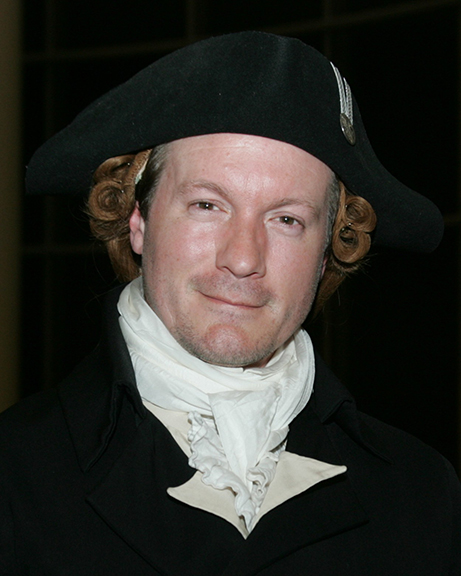

Story and photos by Darl DeVault, contributing editor

Over two evenings in early March, a predominantly senior audience gathered at the Oklahoma History Center to gain insights into our country’s early years. The focus was on the drafting and revising of the early U.S. Constitution, presented by Kurt Smith, a renowned interpreter of President Thomas Jefferson.
While in Oklahoma, this dynamic storyteller and historian gave numerous presentations to school groups at the Center and in Tulsa, with a strong emphasis on students’ questions.
Smith offered a remarkable interpretation of Jefferson’s guidance in the promise of self-government, which has now endured for 250 years, serving as a testament to the framers’ brilliance. He often elaborated on the various points when persuasion was necessary to genuinely improve the founding document. He spoke eloquently about how the 13 states needed guidance to collaborate on their many issues.
Here from his highly acclaimed residence as a star performer, Kurt Smith has been portraying Jefferson (1743-1826) at Colonial Williamsburg in Virginia since 2016. The purpose of those enactments by trained actor-interpreters is to “breathe life” into American history by making it more relatable, human, and dynamic for modern visitors. These professional performers move beyond static museum exhibits to provide an immersive “living history” experience that connects past struggles to present values.
His status as a premier historical interpreter is built on a foundation of rigorous research, professional acting experience, and a unique approach to humanizing one of America’s most complex figures.
Smith holds a Master of Fine Arts (MFA) in acting from the University of Iowa. Before becoming Jefferson, he spent seven years as a professional actor in New York City.
Having read all of Jefferson’s 50,000 letters supporting the American experiment, Smith explained how, once selected as the third president at age 58 in 1801, he felt compelled to craft many letters of apology on behalf of the government for actions taken during the first two administrations.
Smith was emphatic about the clarity and authenticity of Jefferson’s ideas. He made it personal, speaking in character as Jefferson by describing his thoughts about his fellow framers of the Declaration of Independence, of which he was the main writer.
He then explained he was dispatched to France as the first trade commissioner for a year and then succeeded Ben Franklin as America’s Minister to France. What started as a one-year posting to France became a five-year mission.
Jefferson, according to Smith, tried his best in letters and by sending crates of books about governments to fellow framers of the Declaration of Independence, which, if read, would have helped the writers of the Constitution create a better document.
First governed by the 1781 founding document called the Articles of Confederation, George Washington presided over the Constitutional Convention in 1787.
Smith’s presentation was lightly grounded in the details but brilliantly conveyed through humanly understandable examples of the many hurdles the fledgling Constitution leaped over to give America its uniqueness in the world.
Back from Europe after the Constitution was written and ratified, Jefferson’s persistence eventually persuaded James Madison to introduce the amendments that became the Bill of Rights in the First Congress in June 1789.
Jefferson believed a Bill of Rights was a fundamental entitlement of every person under every government on earth. He held the omission from the original Constitution in 1787 as a significant mistake. Rather than seeing rights as a secondary addition, his philosophy was that protecting these rights was the primary purpose of government, to be clearly prioritized at the outset.
His specific arguments for why the framers should have prioritized a Bill of Rights included explicit protections for freedom of religion, freedom of the press, protection against standing armies, and the right to trial by jury.
He believed that a written declaration of rights would provide a concrete “legal check” that an independent judiciary could use to block the executive and legislative branches from overstepping their authority.
While many framers focused on limiting the executive, Jefferson was particularly concerned about the “tyranny of the legislatures,” which he felt would be a formidable threat for years to come.
Responding to James Madison’s fear that an incomplete list of rights might be dangerous, Jefferson countered that “half a loaf is better than no bread”—it was better to secure what rights could be defined than to leave them all unstated.
He maintained that while the Constitution’s structure of limited powers was a good start, it was not enough. A written supplement was necessary because the “inconveniences” of having a Bill of Rights (potentially cramping government efficiency) were short-lived. In contrast, the “inconveniences of the want” of one were permanent and irreparable.
Although Madison and Jefferson would argue the issue in important letters they exchanged between 1787 and 1789, Jefferson had first developed the clarity of ideas in his “Notes on the State of Virginia” in 1784.
The Bill of Rights was ratified on December 15, 1791, roughly three and a half years after the U.S. Constitution itself was first ratified in June 1788. While the original Constitution established the framework of the federal government, the Bill of Rights was a reactive addition designed specifically to protect individual liberties and secure the support of states that had initially been hesitant to join the Union.
Jefferson came to power in what he called the Second American Revolution, an attempt to recreate the nation on a much more democratic line than his predecessors had been comfortable with.
Smith wrapped up each presentation with questions from the audience. A hallmark of his “star status” was his ability to stay in character during these unscripted Q&A sessions, drawing on a vast knowledge of Jefferson’s quotes to answer contemporary questions from an 18th-century perspective.
The sessions were part of “By the People: Conversations Beyond 250,” a series of community-driven programs created by America’s humanities councils in collaboration with local partners. The Federation of State Humanities Councils and the Smithsonian Center for Folklife and Cultural Heritage developed the initiative. The Oklahoma Humanities, as the state affiliate of the National Endowment for the Humanities, funded the presentations.