


Have you ever taken a glance at your skin and wondered, “Where did that new spot come from?” As time passes and experience accumulates, so do growths and changes to our skin. Some changes are expected, such as wrinkles or graying hair.

However, many of us experience other changes that our parents forgot to warn us about, and when we are not expecting them, these surprises can be confusing and sometimes even scary.
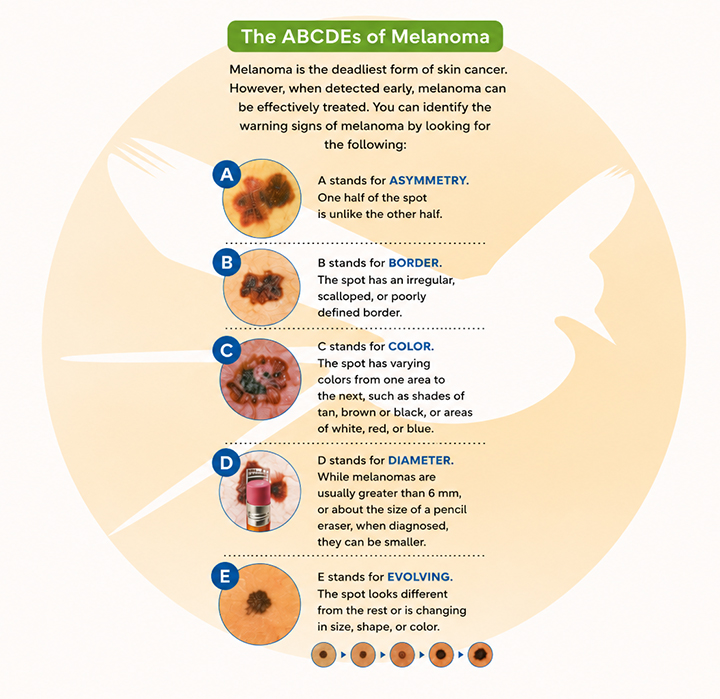
Most people have moles on their body, starting as early as infancy. Over time we watch these moles for changes using the mnemonic ABCDE. This stands for Asymmetry, irregular Borders, atypical Colors, Diameter over a pencil eraser in size, and Evolution or change. These are signs that a mole should be checked by your doctor to make sure that it is not actually a deadly type of skin cancer called melanoma.
In adulthood, a vast majority of us grow spots on the surface of the skin that look like the moles of childhood but are somewhat flatter and have a rough texture. These are known as seborrheic keratoses, or, as some people call them, “age spots.” They can start appearing at any time in adulthood, and they often mimic melanoma. Unlike atypical moles, however, they do not become cancerous. These are hereditary, are not related to diet or sun, and can be easily removed if they become itchy or irritated.
Another common finding in adult skin is the accumulation of permanent bright red spots known as cherry angiomas. Like seborrheic keratoses, these are also hereditary and tend to accumulate over time. They, too, are unrelated to diet, sun exposure, or other external causes. They grow wherever they wish on the skin surface and can easily be accepted as a part of normal healthy skin.
Many patients become frustrated in their 60s and 70s with the progressive thin nature of their skin, particularly on their forearms. This leads to easy bruising under the skin known as purpura. These dark purple patches can sometimes occur even with just a slight bump or pressure and can be further aggravated with the addition of blood thinners that make the bleeding last longer and the bruises more prominent. Purpura are a results of the passing of time and UV radiation exposure from the sun that degrades the skin’s protective cushion of collagen and elastin fibers. When these fiber lose their integrity, the blood vessels below become exposed and fragile, and the outer layer skin becomes easily damaged and sometimes even torn. Using protective sleeves can sometimes provide a barrier when doing heavy work such as yard work or rough play with puppies and children.
Although the findings mentioned above are usually no cause for concern, there are some skin changes that indicate potentially dangerous sun damage. For example, some patients develop rough patches on the sun exposed areas such as arms, hands, and face. These “actinic keratoses” are considered precancerous and can evolve into squamous cell carcinoma, a cancer that, if left untreated, could become aggressive and potentially fatal. Another type of cancer that can develop on the skin is basal cell carcinoma. Basal cells are often clear or shiny bumps that may bleed easily. They can be quite subtle in the beginning and are often ignored as an acne blemish or mole.
Lastly, as mentioned above, melanoma can be sneaky and hide among normal moles or keratoses, mimicking benign growths.
Visiting with your Primary Care Physician (PCP) or Board Certified
Dermatologist can help you determine which spots are normal, which ones can be dangerous, and what your overall risk factors for skin cancer are. As mentioned above, many of the benign spots can mimic skin cancer, and some skin cancers mimic benign spots. Because of this, it’s wise to have your physician give a thorough baseline exam if you are at risk.