

A look inside the quiet months when Oklahoma’s circuses repair, rest, and prepare to roll again.
by Richard Stephens, Jr., staff writer

Did you watch amazing circus acts as a youth? In the warm season, circuses gave one or two shows a day, then drove to the next town. During the cold season, where did Oklahoma’s circuses go?
Then and now, Hugo is the winter retreat, as insiders say. In the circus heyday of the 1940s – 1980s, up to nine rested in Hugo. The last two Oklahoma circuses, Carson & Barnes Circus and Culpepper & Merriweather (C&M) Great Combined Circus, still call Hugo home. What goes on, though?
Repair and relaxation
For the C&M Circus, November to March is a time of reconstitution and relaxation, well-earned after 32 weeks on the road performing one or two shows a day in 200 towns in 17 states. Ronald Dykes and I met in February at the C&M trailer park on Kirk Street. Mobile homes sat next to circus trailers. Dykes speaks softly and knowledgeably about a business he’s been part of for 45 years. These days, he’s an animal caretaker; previously, his family performed a variety of acts.
He explained, “Everybody needs a rest because we work five days a week.” He meant humans and animals. “There’s always repairs. If you can put ‘em off to the winter time you do, because when we travel; it’s traveling every day.”
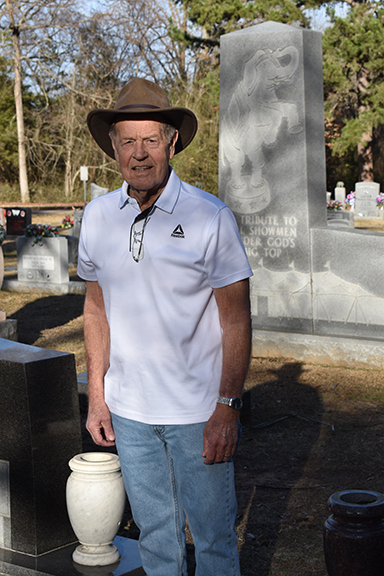
David Rawls, former owner of the Kelly Miller Brothers Circus, and I talked in Hugo’s Olivet Cemetery. Isn’t that an odd place to meet? Not in the circus world – we stood in “Showmen’s Rest,” a 1,000-foot section of the cemetery. He seemed at ease surrounded by family members and friends he knew. Six-feet tall, Rawls was casually, yet neatly, dressed and wore a brown outback hat.
He explained, “It’s repair and maintenance. My winter quarters, we worked typically five days a week. … The performers, a lot of the people went to where they lived, or where they came from. But we had a core staff here, the welders, mechanics, people who could rebuild things, paint. … All of the trucks and trailers had to be gone through. … And if you were gonna buy any new equipment, you bought it in the wintertime, put it into service.”
People Know Their Jobs
Are rehearsals necessary before the new season? Dykes said, “Generally not, because most of the acts are responsible for their own (training).” Rawls’ response: “One rehearsal.”
When I looked astonished, he added, “They already knew their acts. What you had to rehearse for was prop changes, wardrobe changes, the music, new acts. You couldn’t put somebody (performing) in the Flying Act in the next act, and several of them did two or three spots in the show. You had to make sure the wardrobe changes were possible, the rigging changes were possible.”
Former Acts
Dykes’ family used to perform a variety of acts, including one with a horse. “It was called Big and Little. We had a big draft horse and a little miniature pony. And they were like the opposite extremes of what riding could mean. He’d stand there on this little table and she’d go around his legs, in and out. People loved it,” he chuckled. Seven family members also rode unicycles and horses. Dykes juggled and walked a high wire. We discussed what circus life was like.
Hard but Rewarding Work
“In most ways, it’s just like any profession, a lot of hard work,” Dykes said. “It’s in your attitude. … But if you work, participating in the show and doing what you can to help other people out, it makes it a better experience … it was the circus people that made me want to be there.”
Rawls also loved circus life. He formed a partnership with the great D.R. Miller in 1984 and they successfully toured America and Canada for 25 years. Previously, D.R. Miller operated the AL G Kelly & Miller Brothers Circus and the Carson and Barnes Circus. Representatives from the Carson and Barnes Circus were not available to contribute to this story.
“There wasn’t anything better than being on a green, grassy lot, blue sky, and a tent full of people,” he remembered. “The music playing and people coming out of the tent. … I also had a lot of friends around the country.”
A Tradition That Endures
Rawls closed by saying, “When the kids become teenagers, they become fans of the carnival. And then when they have children, they come back to the circus.”
Today, fewer, smaller circuses tour but two still come home to Hugo in the winter, carrying on a wonderful tradition.