


by Richard Stephens, Jr., staff writer
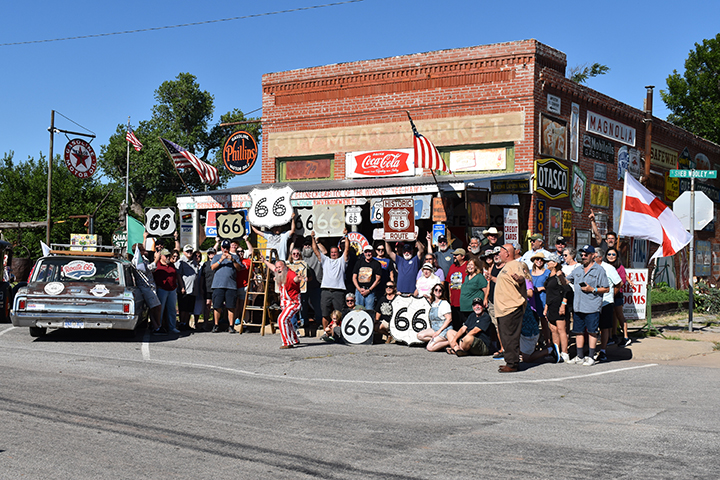
On June 17, the Main Street of America Route 66 Centennial Caravan tour, organized by the Route 66 Road Ahead Partnership, entered Oklahoma. At the nearby Will Rogers Highway marker, Rhys Martin, Caravan organizer and trip leader – who also serves as President of the Oklahoma Route 66 Association – explained its significance. Listening were 12 core Caravan members who drove the entire length of Route 66, one from each of the eight Route 66 states, plus other representatives, including two Dutch travelers.
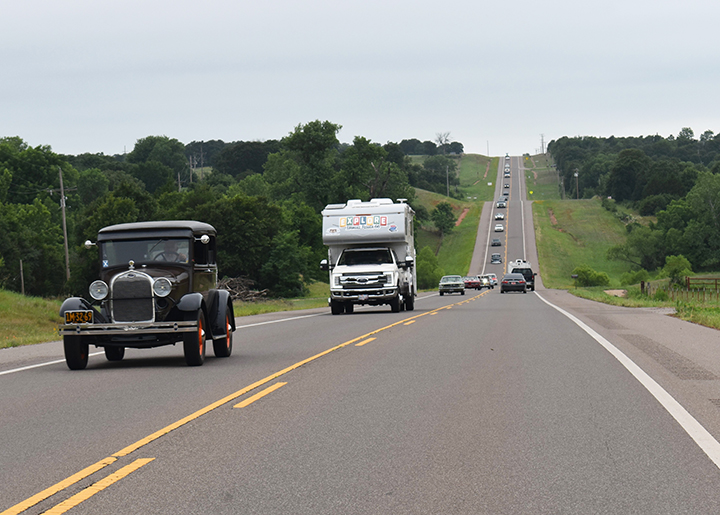
Over the next three days, the Caravan traveled 460 miles and visited 20 sites in Oklahoma. That left time for Caravanners to savor our remarkable state and for me, travelling as a Friend of the Caravan (kinder than “add-on”), time to get stories. As members of the public joined and left at stops, the motorcade fluctuated between 45 and 74 vehicles. Some travelers noticed western Oklahoma’s red clay bluffs turn to green grass and trees in eastern Oklahoma.
Background
By the time Caravan members rolled into Oklahoma, they were already seasoned travelers after crossing Route 66’s cactus-filled deserts for 11 days from California to Texas.
The National Trust for Historic Preservation noted that beginning on June 6, they had embarked, “on a 2,400-mile, three-week journey from Santa Monica to Chicago, making multiple daily stops along the full stretch of the ‘Mother Road’ in celebration of its 100th anniversary. Crossing all eight states along Route 66, the caravan will spotlight preservation success stories.”
Each night, The Big Texan Steak Ranch of Amarillo offered a free 72-ounce steak dinner for whomever finished the steak and all the trimmings within an hour.
On the Road
At our first stop in Erick, Harley Russell met us outside his Sandhill Curiosity Shop. Dressed in his trademark red and white striped overalls, the troubadour greeted our 70-person group and found just enough time to lead us in the Route 66 song before we headed east.
With a convoy stretching one-and-a-half-miles long that included a 1929 and 1930 Ford, four campers and a car-carrying semi-trailer, that day – and every day – we consistently ran behind schedule at the Stafford Air and Space Museum (Weatherford), Anna Mitchell Cultural Center (Vinita), and all the others. But this wasn’t an airline, right?
There were informative briefings from Matthew Radcliffe, the State Capitol Architect and Curator, Ed Threatt at the Threatt Filling Station, curators at the Anna Mitchell Cultural Center, and others.
We noticed and appreciated smiling, waving groups of local residents in Erick, Sayre, Canute, Edmond and Catoosa – and many other communities. Two large groups of children gathered in Luther and Edmond.
At Catoosa’s Blue Whale, John and Melissa Gona of Indianapolis spoke about the trip. He said, “Oklahoma is obviously the best slice (of Route 66). People here are amazing…we love traveling on Route 66 in Oklahoma.”
Personal Stories
Route 66 stories can be enlightening. Karen Roth of Sun City West, Arizona, recalled traveling Route 66 in 1971 with her mother and four siblings in a station wagon. “Kids would fight over the back seat of the station wagon…and we drove from California all the way east.” Roth added, “I figured that spending one of my retirement years doing Route 66 was a bucket list kind of item that I wanted to do.” Now 66, she and her husband, Ronnie, drove the entire length with their two cats and two bicycles and met her father-in-law, 94, along the way.
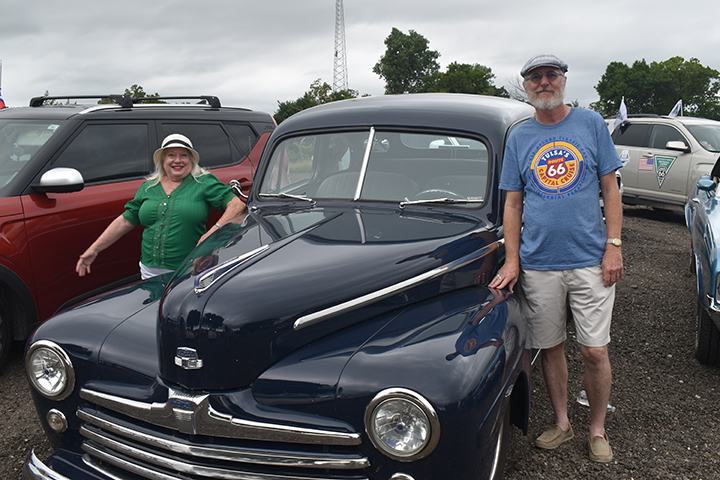
At Wellston, Mike and JoAnn Wilkerson from St. Louis shared that he found the Caravan trip on Facebook, decided to drive it as their first Route 66 end-to-end trip and bought a 1947 Ford Super Deluxe Coupe to do it in. JoAnn’s goal is to, “Meet people, enjoy America, and so many people have been so kind and so gracious. And it brightens our outlook. The news is so negative but Route 66 is so positive.” Mike added, “It’s all about small towns, and we call them the relics, the restorations, the revitalizations, and the reimaginations that we’ve run into. The four “Rs” of Route 66, and then the fifth would be the real people.”
Dodging farm tractors, oil and gasoline semi-trucks and SUVs throughout the trip, I was reminded that Route 66 continues to be relevant for small town America’s commuting purposes: work, school, shopping – everyday life. People cruising down memory lane or in a “golden age” bubble intersect with reality.
Preservation
Nikki Turleski, the Director of Operations for the Historic Route 66 Association of Arizona and a core trip member making her first complete trip of Route 66, emphasized adaptability.
“Preserving historic businesses, buildings, repurposing buildings into something new so they can be preserved for generations to come, we think that’s very important to the vitality and the longevity of Route 66.” She used Route 66 Motel in Kingman, Arizona, as an example. “Catholic Charities renovated it into low-income housing. So, the structure is still there, the neon sign is still there. It’s still benefiting our community, but it has a different purpose now.”
Oklahoma has awarded a total of $12,800,970 of taxpayer money to 47 municipalities, nonprofit organizations and government entities on Route 66 for historic preservation or economic development since 2024 from the Oklahoma Route 66 Route 66 Revitalization Grant Program. The money repaired, replaced, enhanced or added to historic structures and neon signs like Hamons’ Court in Hinton, The Service Station in El Reno, even a “musical road” on Tulsa’s Southwest Boulevard Bridge that plays a song from Woody Guthrie when one drives over it. Members of the Caravan appreciated them.
Perspectives
At the High-Way Café in Vinita, Martin reflected on the journey. “The…Caravan has been very rewarding to organize and execute. There have been people from all over the country, and, I mean, internationally, that have joined us…And they’ve gotten the opportunity to hear stories from people that are a big part of the Route 66 community, see landmarks, and just really experience the highway. My hope is that they see what I see, and that it’s not just a road of the past and a wonderful history, but there’s so many new things happening, too.”
After visiting Commerce, the Caravan crossed the state line, then disappeared north to see roadside treasures in Kansas, Missouri and Illinois.