

The 72nd Air Base Wing (ABW) hosted a 9/11 ceremony outside and inside the Tinker Event Center on Sept. 11.
By Richard Stephens, staff writer
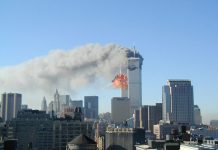
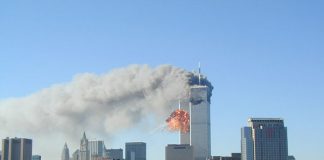
Outside, after presenting the colors, taps was played and salutes were rendered. As Nathan Schooling, Tinker’s Fire Chief, recounted the events of 9/11, Airman Marissa Daniels, 72 ABW Security Forces, rang a bell for each time a commercial airplane struck a Twin Tower, the Pentagon, and Shanksville, Pennsylvania.
Col. Fencisco Harris, 72 ABW and installation commander, reflected how 9/11 affected him as a young Airman at McConnell AFB, Kansas, and how the attacks reshaped the world. Lt. Col. Rudy McIntire, 72 ABW Security Forces Commander, gave examples how the security forces mission dramatically changed after 9/11 and how deployments affected Airmen.
Oklahoma City Fire Chief Richard Kelley offered a broader national perspective, describing the attacks and his experience standing at Ground Zero two months later during a Rand review of the response. He said, “In just 102 minutes, nearly 3,000 lives were taken. Today, we gather not to simply remember a tragedy. We gather to remember the people, the lives lost, the fearless responders, and the resilience of the American spirit.” He ended by saying he wants the enduring image of September 11 to “be of the rising people, perseverance, the strength of helping hands, and the resilience of a nation that came together.”

Responding to uncertainty
Inside, after breakfast, four panelists shared how they responded during 9/11. Three were assigned to the 552nd Air Control Wing at the time: retired Brig. Gen. Ben Robinson, commander; retired Col. Jimmy Patterson, a senior pilot; and retired Lt. Col. David Hannah, a mission crew commander who launched an E-3 that day. Retired Master Sgt. “Jay” Orr, then assigned to Andrews AFB flying UH‑1N helicopters, completed the panel.
Orr described the surreal quiet over Washington, D.C., as he flew his military helicopter because no other aircraft were airborne. “We proceeded our mission and flew right by the Pentagon and saw where the aircraft had impacted on the Pentagon…All the passengers on board, flight crew – we were just in awe, just silence. Not a dry eye on that aircraft that day.”
Hanna remembered the day’s rules of engagement for aircraft with a suspicious profile: “We were given the authority to engage and shoot it down.” Robinson added, “Imagine you’re an aircrew member on a military airplane and you’ve just been given the authority to direct a fighter to shoot down a civilian airplane full of innocent people. That’s what that came to.”
To get members of his wing out of waiting lines to enter Tinker and fix and fly jets, Robinson, Col. Altendorf and a security forces Airman identified a good place in the back of the base and cut a hole through the perimeter fence – yes, cut – with bolt cutters. “ So, he (Altendorf) proceeds to cut a nice hole through the fence, big enough to drive through,” said Robinson. Local police departments were notified, police car lights flashed to direct service members to enter and the new “AWACS” gate worked.
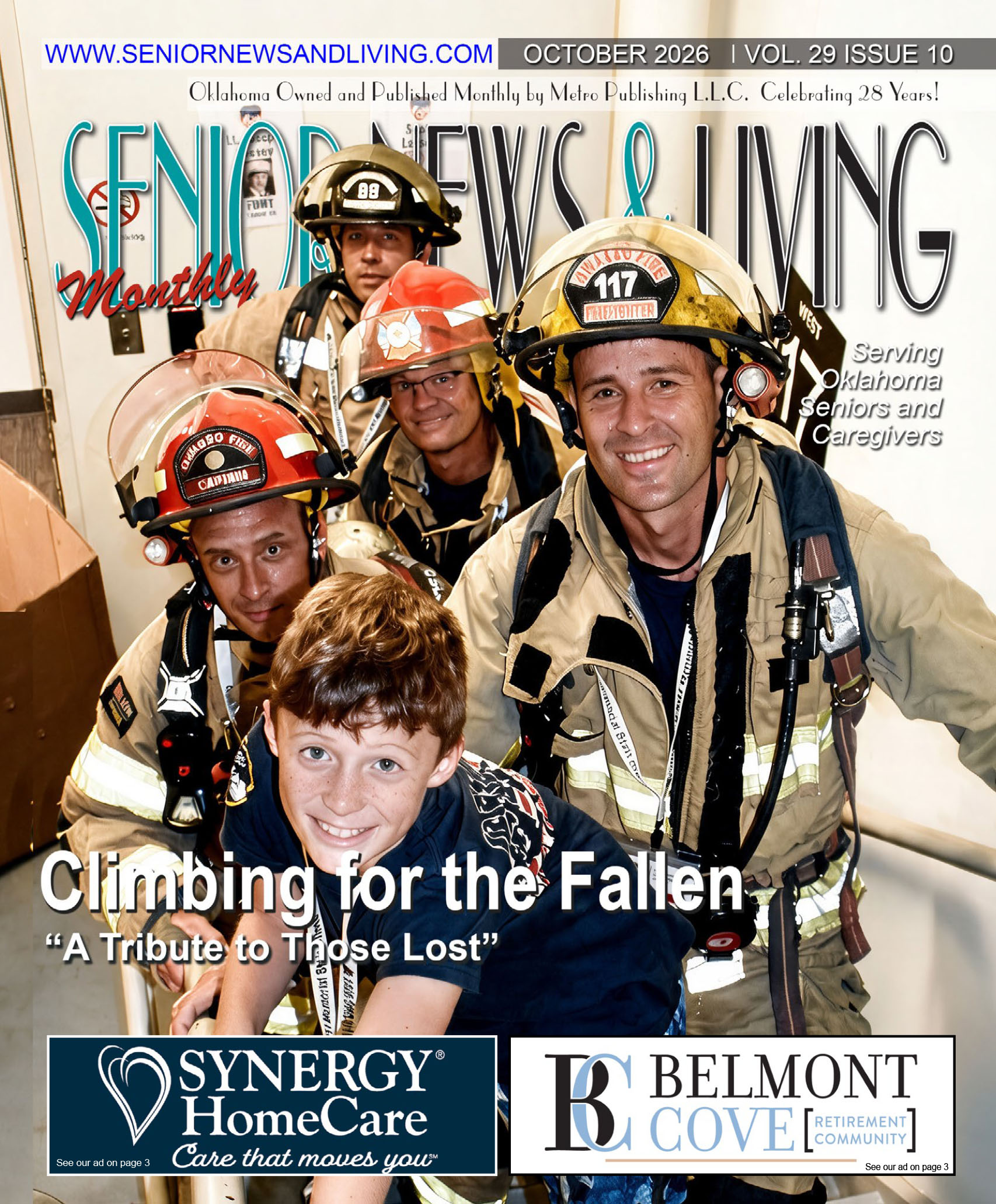
Climbing for the Fallen
The 15th annual 9/11 Memorial Stair Climb honored first responders and civilians from Flights 93 and 11 who perished in New York City that terrible day and raised money for the Oklahoma Firefighters Foundation. The Foundation provides free lodging for Oklahoma families and first responders visiting firefighters and burn victims receiving medical care.
Five hundred and thirty-nine firefighters, law enforcement officers, and EMTs from 122 departments in five states and civilians paid $54.31 and climbed a total of 110 floors in three towers in downtown Oklahoma City. Co-coordinators John Linley and Sherry Summers, helped by 100 volunteers, held a well-organized event.
“The Oklahoma Firefighters Foundation is a 501(c)3 non-profit organization who helps cover hotel costs for first responders, burn survivors, and their families in their time of need while their loved one is hospitalized,” emailed Linley. “Since our last Stair Climb…we have helped 18 families, 379 nightly stays, covering $36,000 of expenses.”
The purpose matters
Before climbing, participants shared why they return each year. Dylan Pearson, of the Chickasha Fire Department, said, “Well, on a personal level, maintaining a fitness goal is pretty important, so it kind of serves as a benchmark for that… Being a firefighter is a fairly closeknit brotherhood and we don’t forget them. They went out there to do a job. We try to finish that climb for them.”
Mark Tate, a 71-year-old retired Lawton fire fighter, has participated 12 times “It’s just remembering those who sacrificed and supporting our local guys. It’s something that we still get to do with the fire department.” He added, “It’s very humbling to represent those who have given their all.”
Stair climbing
After honoring our national symbols, taps and bagpipes were played and retired Midwest City firefighter and emergency manager Mike Bowers spoke. Climbers ascended stairwells about 8:47 a.m., when Flight 11 hit the north tower of the World Trade Center. Unlike the heroes of that day who made a one-way trip, climbers rode elevators down.
I walked the first 29 floors with them, starting and stopping along the way. The stairwell was warm with little air conditioning, I sweated through slacks and a shirt and my heart palpitated. Law enforcement officers wore 20-30 pounds of gear and firefighters, 40-50 pounds – much more strenuous!
Groups of family clapped and cheered for participants as they walked between the Oklahoma Tower and the South and North Leadership Square Towers at 211 N. Robinson Ave.
Carrying their weight
At the finish line, turnout gear and hair were soaked with sweat, faces flushed, and legs exhausted — but climbers completed a great test of will power and endurance. They placed tags bearing the names of those they honored on an Accountability Board, rang a bell for closure, and reunited with family.
Among the climbers was Al DeRubbio, 65, accompanied by 21 others from Wichita Falls, Texas. “All four of my brothers were fire department of New York” he said. “They were all there that day. All of them. Three made it out. Dave (fourth brother) didn’t make it out.” One brother, Don, was a battalion chief. “He was guiding people into the building because he was a chief. And then my other two brothers arrived after the towers collapsed and they were on the pile a little bit.” The two brothers were sent home to ensure their safety. “We lost Dave on 9/11, and I just wanted to do something to remember, you know, not only him, but all the firefighters, and all the current firefighters throughout our country” he explained.
The climb was a physical and emotional journey — one that keeps participants returning year after year.
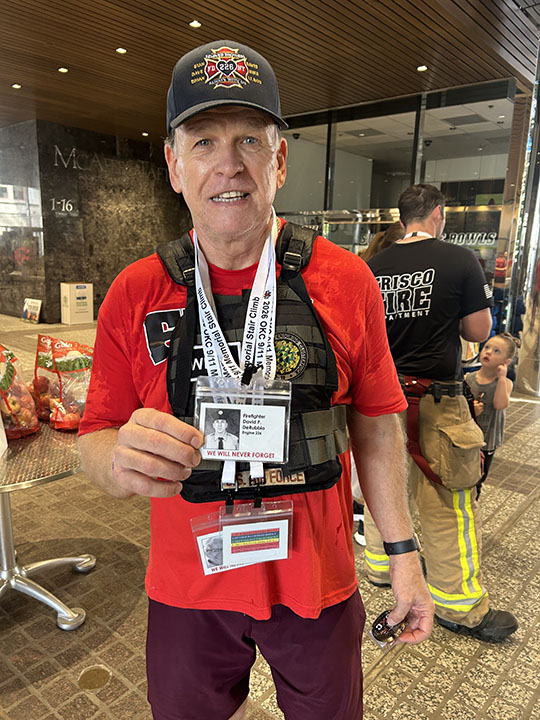
DeRubbio, a NYC firefighter who died on 9-11. His group of 22 came from Wichita Falls, Texas.