

By Richard Stephens, staff writer
Western emigration across America changed dramatically over time – the National Cowboy & Western Heritage Museum’s exhibit explains how.

During Route 66’s Centennial year, the National Cowboy & Western Heritage Museum wanted to inform visitors how the means of transportation people used to emigrate from east to west changed over time. The exhibit, “From Trails to Truck Stops,” resulted. The exhibit shows from February 6 – May 3, 2026.
Question. Why would the National Cowboy & Western Heritage Museum – a museum dedicated to informing people about cowboys, American Indians and western movies and displays western art – hold an exhibit about a highway called Route 66?
Answer. “The story of Route 66 is a Western story…And it is certainly a very important part of Oklahoma history,” said Seth Spillman, Chief Marketing Officer at the museum. “We are here in Oklahoma because of Route 66.”
Spillman said in the 1950s, three cities were finalists to host a national western museum: Colorado City, Colorado, Dodge City, Kansas, and Oklahoma City (OKC). OKC was chosen because “Oklahoma City…donated the land that the museum was on, but that land is on Route 66, and (in 1955)…having that traffic off of Route 66 was an important part of that decision.” He added, “I believe it was the 1954 reroute of Route 66 through Oklahoma City that follows the same line that I-44 is now. They just paved I-44 over Route 66 and used that.”
Spillman explained, “So, you have the trails and then you have the railroads that followed those trails, and then the highways that followed those railroads in many ways.” Each method of travelling replaced the other, shortening times needed to travel.
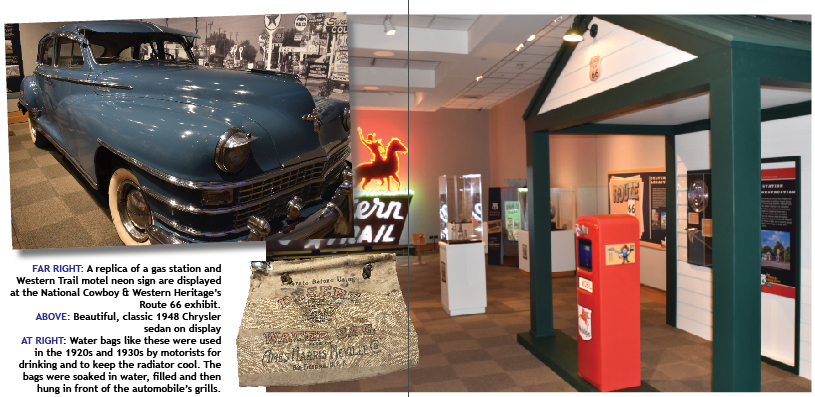
The exhibit uses maps, photos, vehicles, artifacts and giant information boards to tell the story.
Three rooms of displays
The first room (entrance), named, “Mother Road,” shows license plates and various road signs from highways, like Highway 3 that was absorbed by Route 66.
The second, “Ways West,” room displays maps (Santa Fe Trail, railroads, highway and a comprehensive “1820-1870 Western Emigrant Trail” map
Also, there’s an interactive Google Arts & Culture display called “Route 66 Rewind” that puts you (virtually) in a car, touring towns as they used to look on Route 66. Unfortunately, there is no mention of the Ozark Trail or Jefferson Highway in Oklahoma.
Room three is the most interesting for visitors. Called “Roadside Attractions,” it offers diner seating, two classic cars, a buggy, gas station, Western Trail motel sign, ash trays, railroad tools, water bags that used to hang in front of radiators and lots more. Children can pick up a handout called, “Start Your Engines!” with games.
Information boards in each room provide details about the paving, heyday, decline and rebirth of Route 66, how highways led to roadside attractions and why the Cowboy Museum was built in OKC.
What has been customer feedback? Spillman said, “We’ve been very pleased that they’ve been pleased with what we’ve had he”. Jim Berryman from OKC commented, “If you’ve ever travelled as a kid on ’66, then you’ll definitely want to see this. Very well done.”
The museum expects to install a 35-foot-tall cowboy boot called “66 Kicks,” made by Cameron Eagle in April. Spillman said it will be installed on the east end of the museum’s property adjacent to I-44.
Visit the museum’s website, National Cowboy & Western Heritage Museum – Oklahoma City, OK, or https://nationalcowboymuseum.org/, to learn more about the exhibit and when “66 Kicks” will be installed.