

Story and photo by Darl DeVault, contributing editor

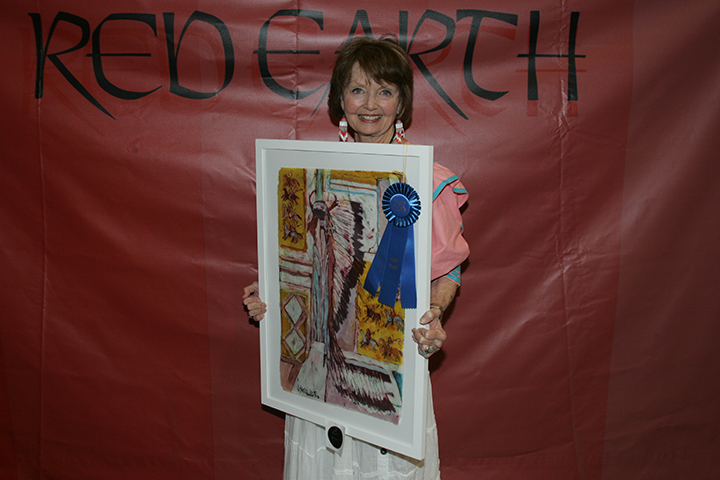
In keeping with her revered status as the Honored One at the two-day 2026 40th Annual Red Earth Festival, Choctaw Nation of Oklahoma artist Jane Semple Umsted is, in several other dimensions, Oklahoma art royalty.
“All of my life I have been so proud of my Choctaw Heritage,” Umsted said in an interview. “It is so much of who I am and what I speak to in the creation of my art.”
Umsted, 79, is a premier cultural bearer, master artist, and historic icon within the Choctaw Nation. Her deep-seated connection to the tribe spans more than 50 years of artistic practice across painting, sculpture, and intricate batik.
“Actually, there has never been a time that art has not been a part of me,” Umsted said. “My mother was an accomplished artist, and all of my siblings have the gift. Because I have had so many years of creating, it seems natural for me to work in a variety of media.”
“Being at Red Earth in those early years reminded me of the Indian Expositions at Anadarko that my family attended when I was very young. That was so magical for me, and those experiences became my lifetime inspiration.”
Back downtown after moving to several venues the last few years, the Festival staged the dance contests in the same hall as the booths. “I absolutely loved having the dance competition as an integral part of Red Earth once again. Hearing the drummers and seeing the dancers filled my soul with joy.”
Her prominent Choctaw heritage stems from her direct descent from the highly influential Choctaw leader Peter Pitchlynn, her great-great-great-grandfather. He served as the Principal Chief of the Choctaw Nation from 1864 to 1866 and spent 30 years as a congressional delegate, fiercely protecting Choctaw land claims.
Her uncle, William F. Semple, served as Chief of the Choctaws during the 1920s. “My grandfather was an original enrollee, signing when he was 16 years old. Uncle Will was his brother and was the only Choctaw Chief who was an attorney. He received his Law degree from Washington and Lee.”
Her steadfast celebration of Choctaw culture earned her the “Honored One” booth at this year’s show on August 1 in downtown Oklahoma City. A focal point of the Festival, it was located at the very front of the exhibition hall.
In addition to the Festival’s highest honor, she earned two awards in the juried art competition. She won First Place in the Drawing, Printmaking and 2D Mixed Media category and Third Place in Sculpture. “It was such a humbling experience to have received these awards, Umsted said. “Competition is once again at a very high level at Red Earth. Having the Festival at the OKC Convention Center was a wonderful experience. It is such an ideal location, and it is so beautiful!”
Her meticulously researched artwork is widely respected within the Indigenous community for its historical accuracy. It captures the spiritual and physical histories of the Choctaw people—ranging from ancient Mississippian designs to the tribe’s modern journey.
That level of detail and devotion to her Choctaw heritage also earned her an appointment in 2023 by the President of the United States to the Board of Trustees of the Institute of American Indian Arts (IAIA), recognizing her national standing in the arts community.
“The institute was founded in 1962 in Santa Fe and has been the leading force to guide and inspire young Native Art students all these years, Umsted said. “Today it has expanded its offerings to a wide range of degree programs to serve students all over the United States and beyond.”
When she was one of five appointed to the IAIA board, Gary Batton, Chief of the Choctaw Nation, said, “Jane Semple Umsted is a brilliant artist as well as a loving and humble person. She represents the Choctaw people so well in her artwork and in her daily life. She is a shining star for the Choctaw Nation and is very deserving of this appointment.”
In 2024, she was inducted into the Oklahoma Women’s Hall of Fame, in recognition of her enduring contributions to the state’s culture.
Since graduating from the University of Oklahoma with a Bachelor of Fine Arts in 1969, Umsted has built a multifaceted career. She has blended professional art with education and public service. She earned a Master of Education from Southeastern Oklahoma State University in 1989 and spent years as an art educator, retiring from Durant Middle School in 2007. “I love my years in the classrooms; teaching gave me such a sense of satisfaction and joy, sharing my knowledge with my students,” Umsted said.
Now living in Durant, she helps preserve and promote Indigenous art as the curator of the Semple Family Museum of Native American Art at Southeastern Oklahoma State University.
The Choctaw Nation has consistently commissioned Umsted to anchor its most sacred public and institutional spaces through her larger-than-life visual storytelling. The tribe’s premier cultural preservation facility, the Choctaw Cultural Center in Calera, Oklahoma, prominently showcases her work.
“I feel so blessed to have been able to continue my art profession after I left the classroom,” Umsted said. “The Choctaw Nation has provided me with so many opportunities to express my God-given abilities. This has enabled me to share my art with a wide range of First Americans.”
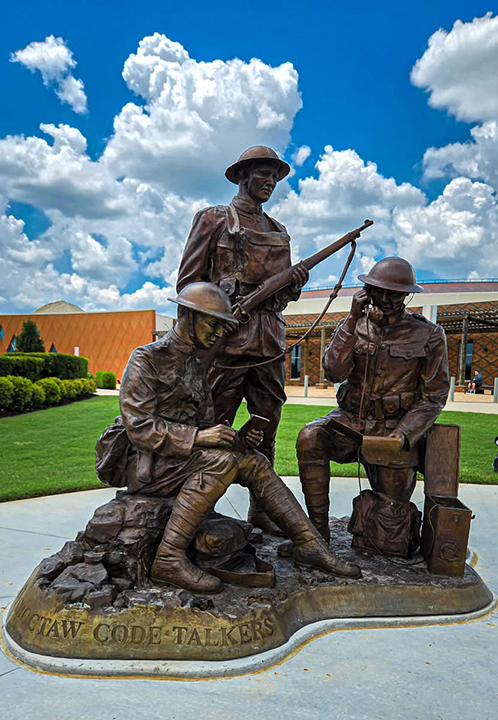
This includes her three specialized 24-inch-tall bronzes titled Emergence, Migration, and Archeological, on display at the Cultural Center. In May 2025, she unveiled a life-size, three-figure bronze monument titled Chahta Anumpa i Tvshka Hoke (Warriors of the Choctaw Language). This life-size bronze stands outside the Cultural Center as the definitive tribute to the WWI Choctaw Code Talkers.
The Choctaw Nation is the third-largest Indian Nation in the United States, comprising 230,000 tribal members and 3,000 associates. The tribe’s oral tradition dates back more than 13,000 years, and it was the first to traverse the Trail of Tears.
Its reservation spans 10,923 square miles in southeast Oklahoma. The Choctaw Nation’s vision, “Living out the Chahta Spirit of faith, family and culture,” is evident in its ongoing commitment to creating opportunities for growth and prosperity.